

- API responses include it in the
x-correlation-idresponse header. - Automation test runs expose it when execution completes or fails.
- Activity events store it as
source.correlationId. - Filtering Activity by
source.correlationIdshows the related events for the same request or execution chain.
Debug a failed run
1
Reproduce the issue once
Trigger the failing action from the same entry point a user uses: page action, form submit, webhook, manual automation execution, or external API call.Keep the timestamp, workspace, user, automation slug, and input payload close at hand. These values help narrow the Activity search if the failure does not expose a correlation ID directly.
2
Capture the correlation ID
If the failing action is an API call, copy the
x-correlation-id response header.If the failing action is an automation test run, use the link or trace button shown after execution. Builder opens Activity with a URL filter such as:3
Open Activity and filter the trace
Go to Activity, click Filter, then add a specific field:
Once this filter is active, Activity unlocks trace-oriented views: Table, Timeline, Graph, and Distribution.
4
Read the trace from the first event
Start with the earliest event in the trace, then follow the sequence forward.Look for the first event whose status is an error or whose payload contains an unexpected value. Later errors are often consequences of that first failure.
5
Inspect the payload and source metadata
Expand the event row and check:
Advanced Activity filters
Use advanced filters when you do not have a correlation ID yet, or when you need to compare several related failures.Filter by automation
Use
source.automationSlug to focus on one automation.Filter by event type
Use
type for one event type, or types for several exact event types.Filter by user or session
Use
source.userId or source.sessionId when debugging a user-reported issue.Filter by app instance
Use
source.appInstanceFullSlug when an imported app or connector is involved.Use the trace views
- Table
- Timeline
- Graph
- Distribution
Use the table for exact inspection. Expand rows to read full payloads, copy IDs, and add filters from individual cells.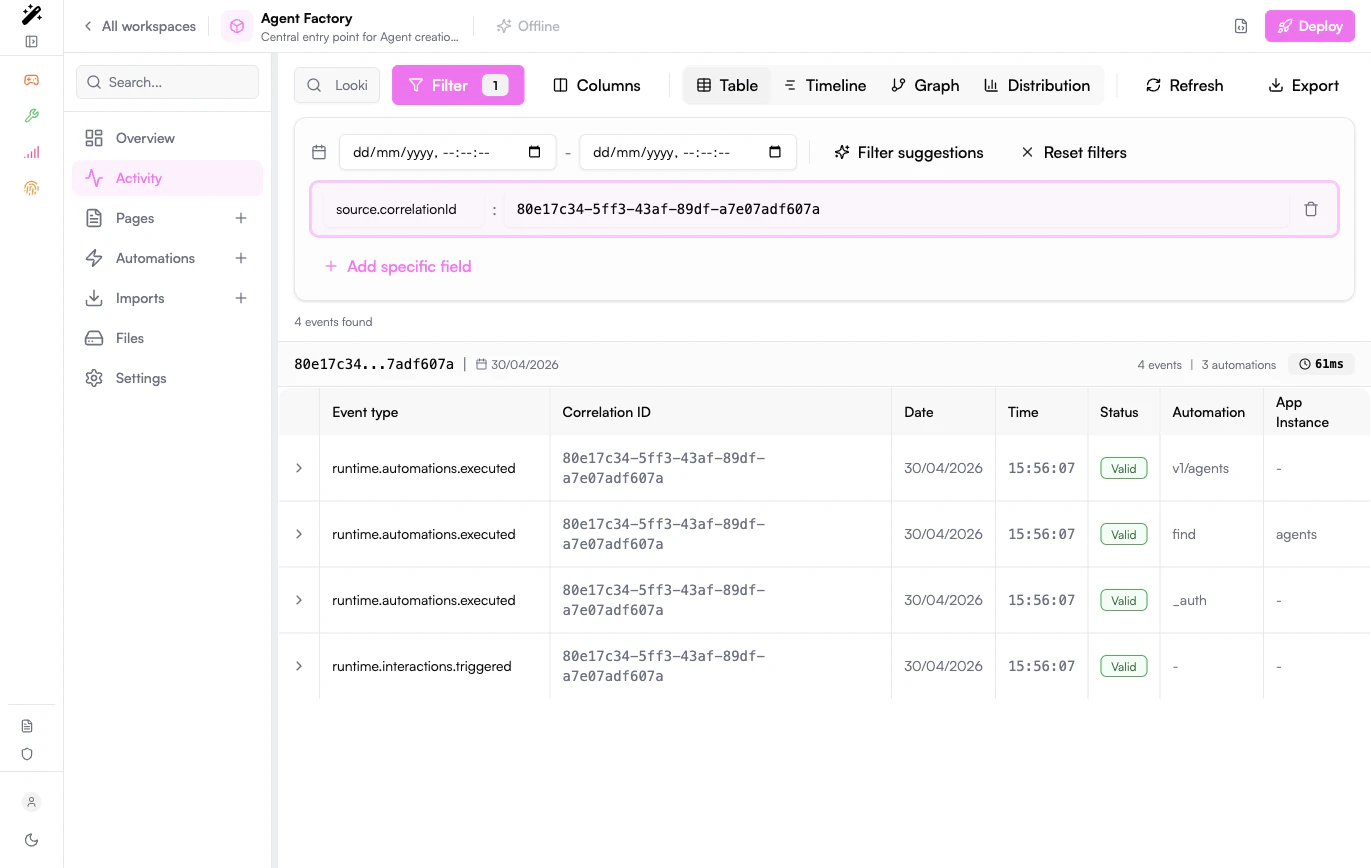
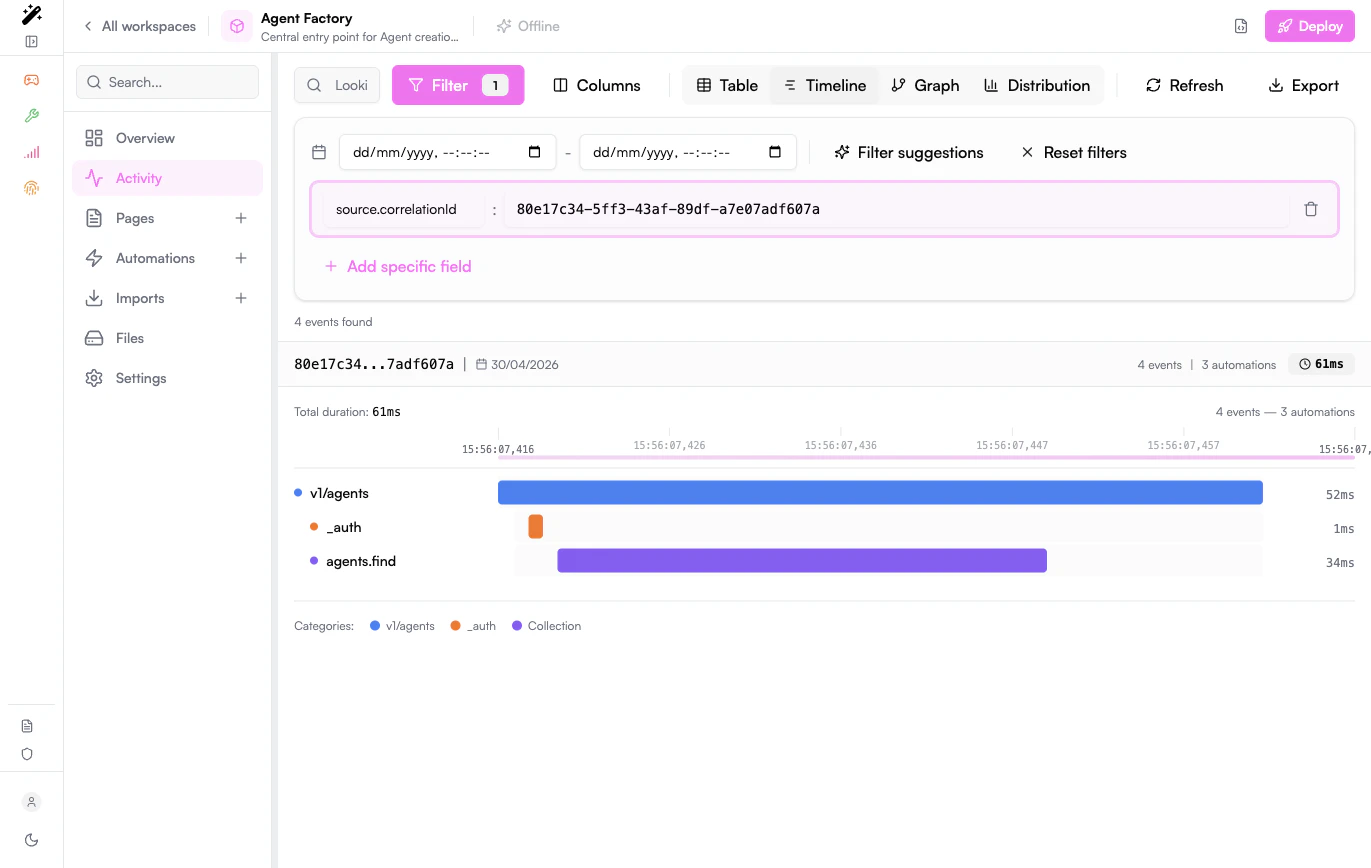
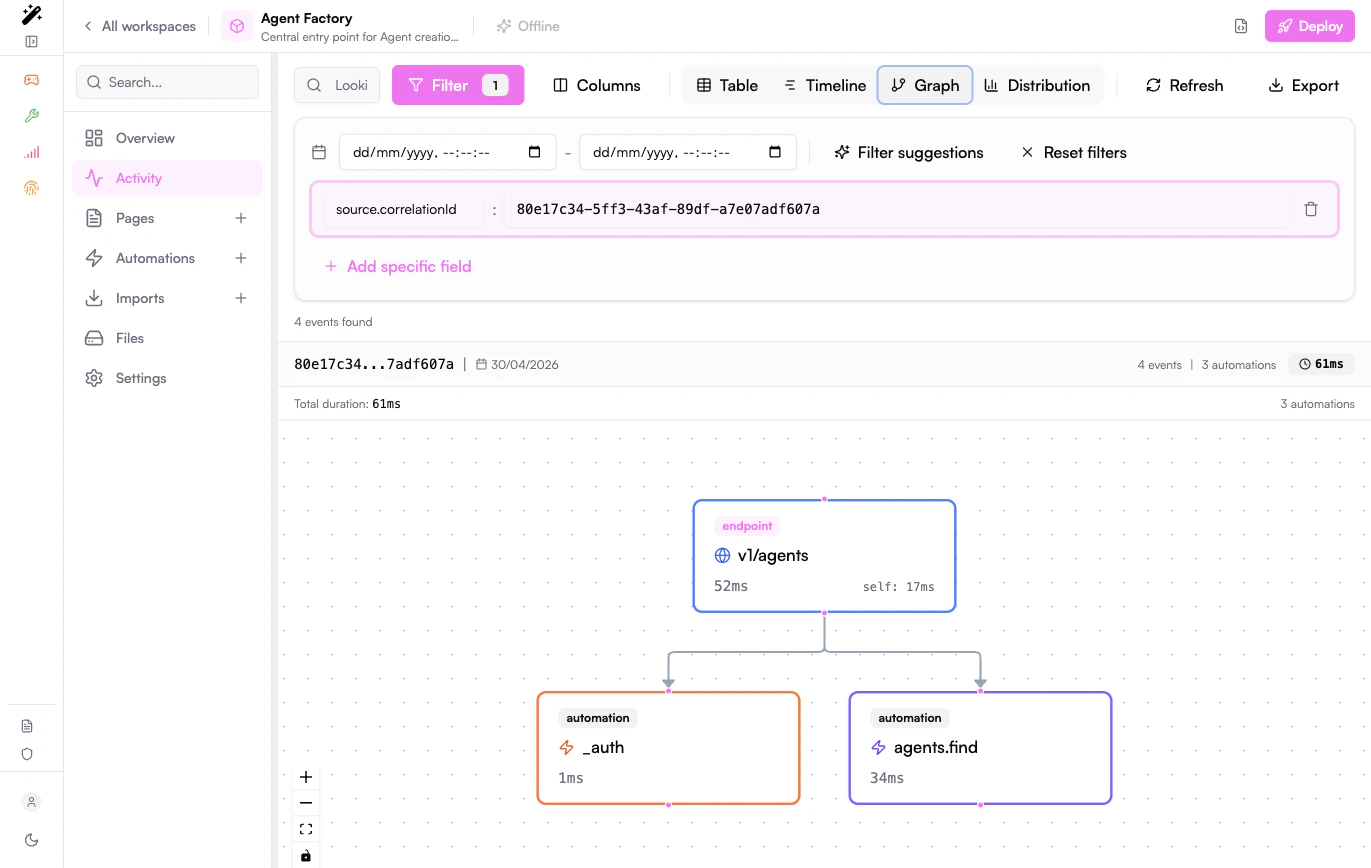
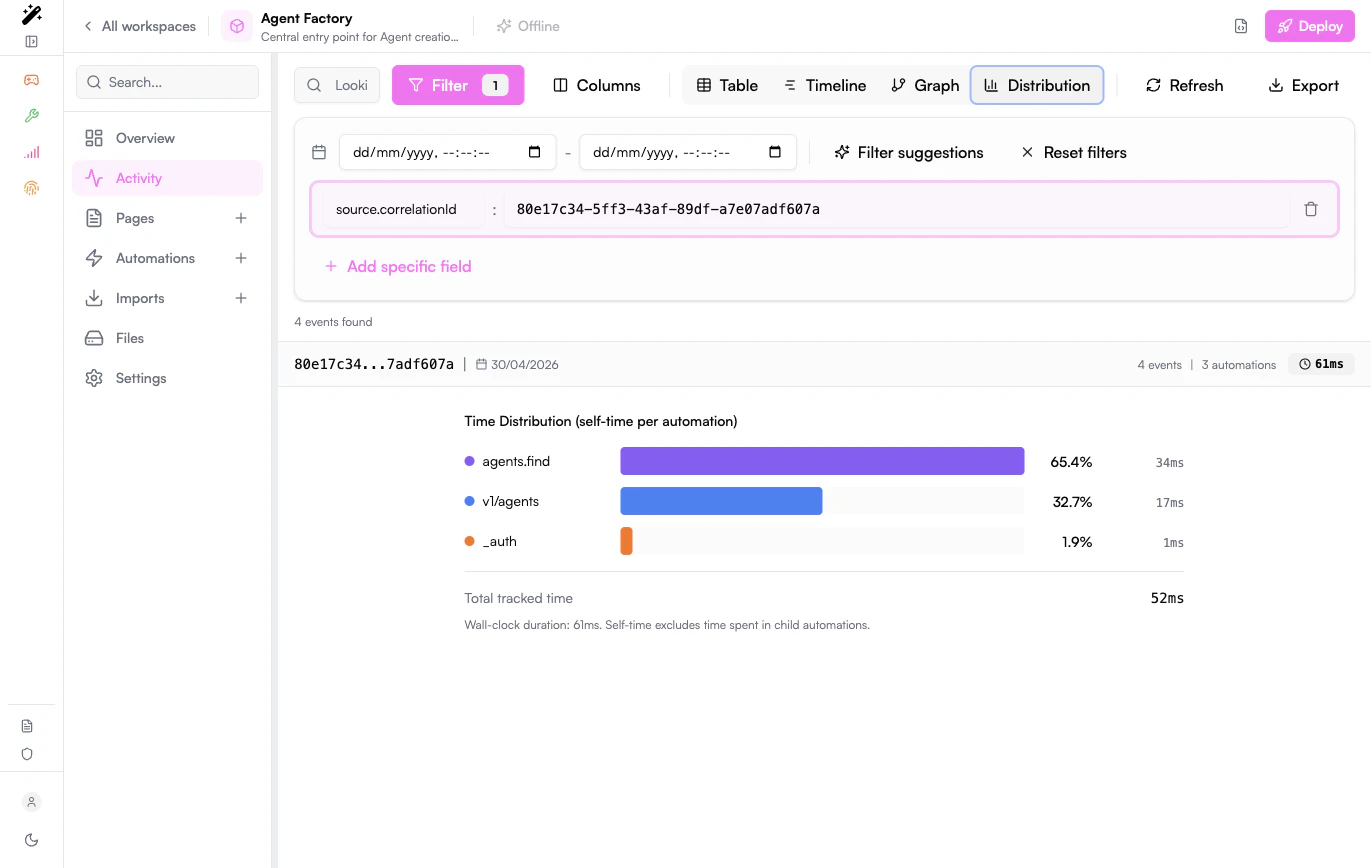
Add useful debug events
For complex automations, emit a small diagnostic event before and after risky steps. Keep the payload structured and avoid logging secrets, access tokens, full documents, or personal data that is not needed for debugging.- Specific: event names describe the step, for example
invoice.debug.payment-failed. - Small: payloads contain only identifiers and the values needed to understand the branch.
- Searchable: use stable field names such as
orderId,ticketId,agentId, orexternalRequestId. - Safe: secrets, tokens, raw credentials, and unnecessary personal data are never emitted.
Test automations
Manual test run
Use manual execution while building or fixing an automation:- Open the automation.
- Run it with the smallest payload that reproduces the behavior.
- Check the output and the generated correlation ID.
- Open Activity from the execution result.
- Fix the first failing event, then run the same payload again.
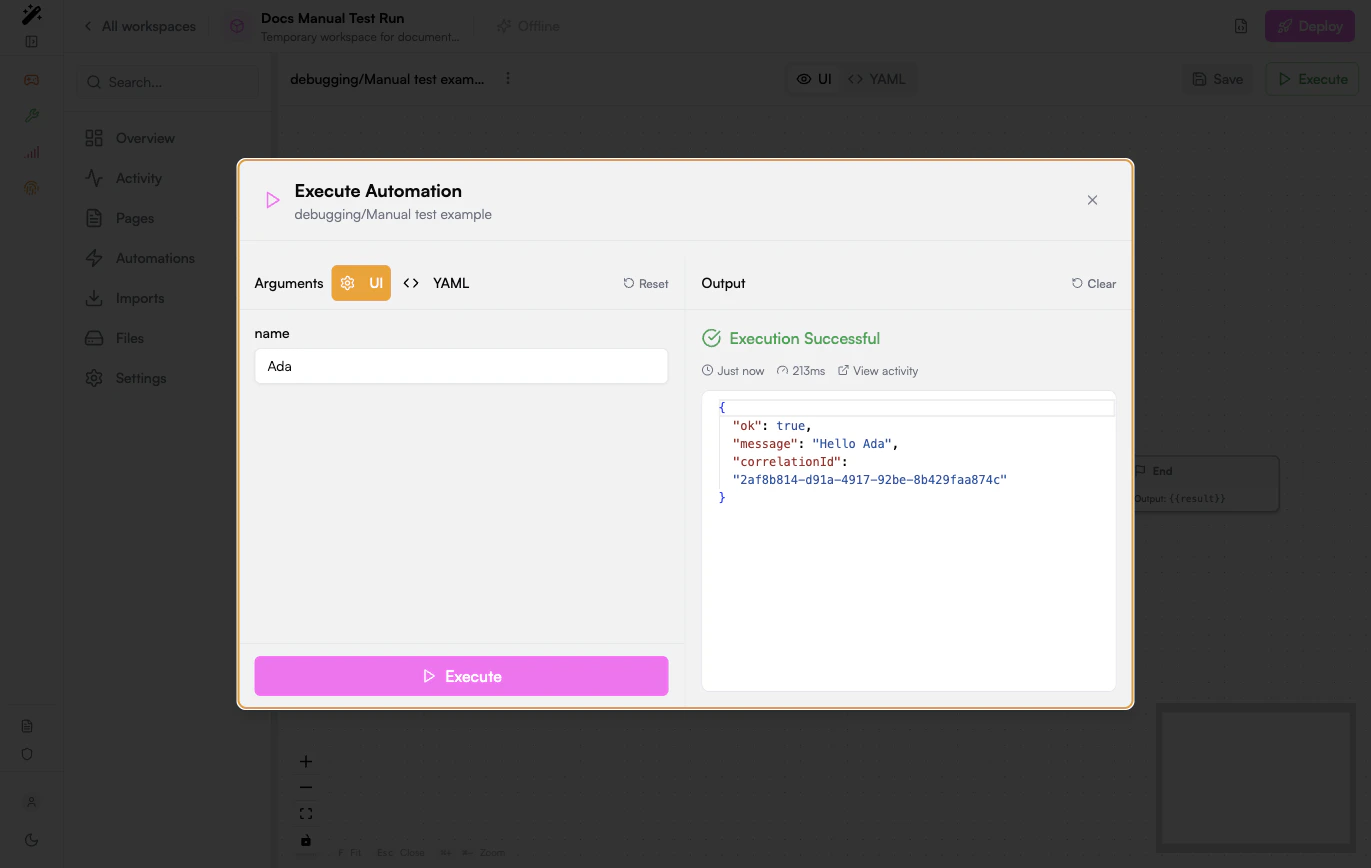
API or webhook test
Use an HTTP client when the automation is exposed as a webhook or called by another system:x-correlation-id response header from the HTTP response and use it in Activity.
Regression test
Before changing a production automation, keep a small set of representative inputs:Test pages and UI actions
When debugging a page, separate UI state problems from backend execution problems.1
Verify the UI event
Trigger the button, form, table action, or page event and confirm that Activity receives the expected event.
2
Check the payload
Inspect the Activity payload and confirm the page emitted the expected values.
3
Follow the backend trace
Filter by
source.correlationId to confirm the event reached the right automation and returned the expected output.4
Return to the page
If the backend output is correct but the page does not update, inspect the React state, event handlers, and response handling code.
Troubleshooting patterns
Performance checks
For load or latency testing, keep the test focused on one stable entry point and always preserve correlation IDs from failed responses.Before escalating
Collect the following before asking another team or Prisme.ai support to investigate:- Workspace ID or slug.
- Automation slug or page involved.
- Exact timestamp and timezone.
- Correlation ID, preferably from
x-correlation-idorsource.correlationId. - Minimal input payload that reproduces the issue.
- Expected behavior and actual behavior.
- Relevant Activity export if the trace contains no sensitive data.